
Wild Life / manatee
water mammals in 2026

Hi, friends — Happy New Year! Let’s do what we can in big and small moments. Let’s appreciate the life around us. Let’s contemplate a herd of sea cows (Trichechus manatus) floating in front of a power plant in Tampa, Florida. With very best wishes to you and yours, and thanks for being there. — Amy Jean
A couple of weeks ago I was in Florida for the first time. We drove more than I expected in a tiny rental car over the longest bridges I’ve ever seen. Pelicans soared alongside, looking like pterodactyls. Dolphins leapt out of the water in pairs just fifty yards from the beach. The sun was relentless, finding every sharp angle into my tired eyes. We were there for a soccer tournament, for my son’s team, and we watched and cheered along expanses of flat, green fields. One of the parents noticed a bald eagle flying low over the runoff pond in the middle of it all, and geese made their customary Vs high in the sky.
Florida, or at least the strip between St. Petersburg and Sarasota, struck me as a postmodern idyll, everything all at once in a sunny, uncanny way. After a game, we went to the beach and sunk our feet into the warm, beautiful sand. A little cafe was decorated for Christmas, and the owners had placed a fake tree with a snowflake toward the shore. It didn’t make any sense, the feeling of summer with the wares of deep winter. And so, somehow, it was fitting that we would make our way to a massive power plant in nearby Apollo Beach, where manatees gather in a cove of warm water.
When we arrived at the manatee viewing center, a volunteer greeted us and said, “There are a hundred!” I thought she meant people, but of course she meant manatees. I didn’t know this was possible. As we walked up the stairs we could smell them, much like the seals of Block Island. People were leaning over the railings pointing to about a hundred dark blobs in the water. Sometimes one of them would lift its nostrils out of the water for a breath. Sometimes one would lift its full head for a look around.
The water was clear, and we could see them gently propelling themselves with their flippers. An old manatee covered in barnacles was being nibbled by little striped cleaner fish. A curious one came right up under us and played with a buoy, while a very small baby hung close to its mother just under the surface. A woman next to me exclaimed in a soft drawl that she had never seen such a young manatee.
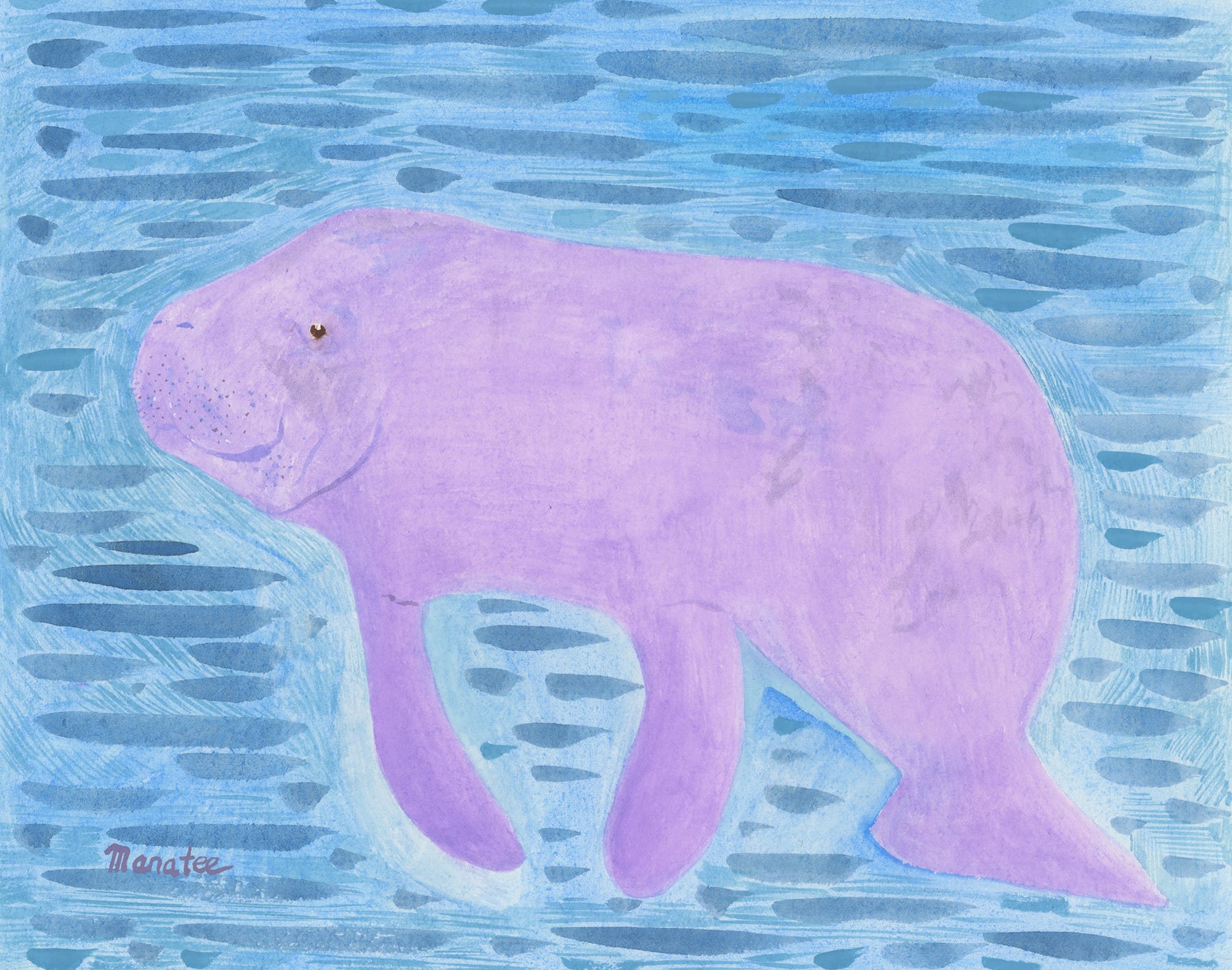
Manatees are big—enormous really—gentle floating water mammals. They are endangered, like most of the big gentle creatures, due to habitat loss. Manatees are herbivores and must graze for hours a day to consume up to 100 lbs of vegetation. They are not good around boats (they don’t hear low frequencies well) and succumb to terrible propeller injuries, but they are smart and communicative and have good memories. In warmer seasons they are semi-social, preferring to graze and travel alone, but they are also happy to be around other manatees. In winter, they look for warmer water, which used to mean traveling south but now it means gathering in the runoff from a power plant.
Afterwards, as we drove through Tampa and its tangle of highways and overpasses, we exclaimed in delight as the sun melted orange and pink into the horizon. In St. Petersburg, two old men dressed as Santa scooted down the sidewalk in motorized chairs as we ate New Jersey–style pizza. A festival promised a “Taste of the North” with sand sculptures and lobsters from Maine. But a postmodern idyll can also be a nightmare. On the road to the airport, we noticed a strange white school bus bearing a medallion from the Department of Homeland Security. With clear eyes we got on the plane and brought home the good and the bad, the warmth and the cruelty. Somehow we must see and understand and hold it all at once.
And so, dear friends, let the vision of resting manatees bring you resilience in the New Year!
Florida manatee links—
“A manatee can move each side of its lip pads independently.” More fun facts at Florida Fish and Wildlife.
Tampa Electric sponsors the Manatee Viewing Center, with videos and information here and a live cam (see the hundreds of manatees in the water right now) here.
Manatees use their big paddle to propel themselves through the water; you can catch a glimpse at National Geographic [via YouTube].
Also —
My sea cow drawing is for sale. Some of the proceeds will go to Save the Manatee.
Wild Life #58 / this free monthly newsletter is a place to learn about the life around us, one gentle manatee at a time. I do this because I’m not sure what to do about the millions of species in danger of extinction. It means something to see and enjoy the life around us. Thanks for your support in 2025! I donated to the Beaver Institute, National Audubon Society, Hawk Watch International, Turtle Conservancy, Cornell Lab of Ornithology, Block Island Conservancy, Bird Note, Wikipedia, and the Wolf Conservation Center. The most popular post was my Valentine’s Brown Rat - ! Please share with a friend if you enjoy reading.
I visited that part of Florida for the first time last February. You captured a lot of what I felt. The beaches and water were beautiful, but we drove through parts of the region that seemed to have been developed in a rush with no thought to aesthetics. We were there for a wedding, which was lovely, but seeing manatees was the other highlight.
Somehow you held the peace and beauty of the manatees together with the risk to the manatees and just a glancing reminder of the current risk to us humans. Thank you. On another note, I have a friend who lives in Bern. I mentioned the exhibit you oversaw while there. She and her husband visited it and enjoyed it. Happy New Year.